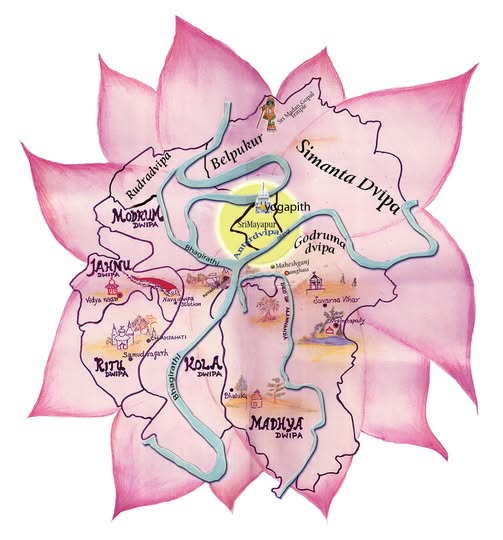
Know about Navadwip Dham
Navadvipa (literally “nine islands”) is not merely a geographical location in Mayapur, but a transcendental spiritual realm described in Gaudiya scriptures. It is compared to a lotus with nine petals, each petal representing a distinct island and a corresponding limb of Navadha Bhakti (ninefold devotional service).
Navadvipa is the land of divine mercy, where the Lord appeared to distribute what no incarnation had ever given so freely — pure love of God. Each island we visit is a step in the evolution of devotion.
Primary scriptural references describing Navadvipa Mandala include:
Sri Navadvipa-dhama-mahatmya
Chaitanya-bhagavata
Chaitanya-charitamrita
Srimad Bhagavatam (Navadha Bhakti verses)
These texts establish Navadvipa as non-different from Vrindavan, yet even more magnanimous due to Mahaprabhu’s audārya (mercy).
Navadvipa is not merely a geographical region — it is the living, spiritual lotus of bhakti. The scriptures explain that this dhāma eternally exists beyond material time, yet becomes visible to conditioned souls by divine grace.
Our great ācāryas, especially Bhaktivinoda Thakura, revealed that Navadvipa Mandala consists of nine sacred islands, each representing one of the nine limbs of devotional service (Navadha Bhakti).
By performing parikrama, we are not simply walking — we are gradually purifying the heart.
The Nine Islands of Navadvipa
Antardwip – Represents Ātma-nivedanam (self-surrender)
The heart of Navadvipa and the appearance place of
Sri Gauranga Mahaprabhu. This island symbolizes complete surrender to the Lord.
Simantadwip – Represents Śravaṇam (hearing)
Glorified as the place where Parvati Devi heard the glories of Mahaprabhu and received mercy.
Godrumadwip – Represents Kīrtanam (chanting)
Known for nāma-saṅkīrtana and devotional gatherings. Associated with ecstatic chanting of the Holy Name.
Madhyadwip – Represents Smaraṇam (remembrance)
A place of deep meditation and remembrance of Krishna.
Koladwip – Represents Pāda-sevanam (service to the Lord’s feet)
Associated with forgiveness and divine mercy.
Ritudwip – Represents Arcanaṁ (Deity worship)
Symbolizes regulated devotional worship and reverence.
Jahnudwip – Represents Vandanam (prayers)
Connected with Jahnu Muni, embodying heartfelt prayers and glorification.
Modadrumadwip – Represents Dāsyaṁ (servitorship)
The island of joyful service mood and humility.
Rudradwip – Represents Sakhyam (friendship)
Associated with Lord Shiva (Rudra), symbolizing intimate devotion and friendship with the Lord.
Antardwip — The Island of Self-Surrender
We begin at the spiritual heart of the dhāma.
Antardwip represents ātma-nivedanam, complete self-surrender. Here the Lord of all universes appeared not with weapons, but with tears of compassion.
During His appearance, the entire land vibrated with the Holy Name. Even unwilling participants unknowingly chanted. This teaches us:
The Holy Name is the deliverer
Divine mercy precedes qualification
Surrender is the foundation of bhakti
In this island, devotees meditate:
“O Lord, I belong to You.”
Simantadwip — The Island of Hearing
Simantadwip represents śravaṇam, the sacred process of hearing.
Here we remember the beautiful pastime of Parvati, who came seeking the mercy of Gaura. Though supremely exalted, she desired only to hear the Lord’s glories.
This reveals a profound truth:
Without hearing, there is no awakening.
Without humility, there is no entrance into the dhāma.
As we travel, we pray:
“May my ears become instruments of devotion.”
Godrumadwip — The Island of Kīrtanānanda
Godrumadwip embodies kīrtanam, joyful chanting.
This island is eternally resounding with the Holy Name. The scriptures describe celestial beings, sages, and devotees immersed in saṅkīrtana.
Here we learn:
Chanting cleanses the mirror of the heart
Chanting awakens dormant love
Chanting is the dharma of this age
Not ritual. Not austerity. Not scholarship.
But nāma.
Madhyadwip — The Island of Remembrance
Madhyadwip represents smaraṇam, remembrance of the Lord.
After hearing and chanting, remembrance naturally arises. The mind, once restless, becomes drawn to Krishna.
This island reminds us:
True meditation is not mechanical effort —
It is the spontaneous attraction of a purified heart.
Koladwip — The Island of Divine Shelter
Koladwip represents pāda-sevanam, taking shelter of the Lord’s lotus feet.
This island is connected with Varaha, who lifted the Earth from darkness. Symbolically, He lifts the conditioned soul from ignorance.
Here devotees reflect:
The Lord forgives
The Lord protects
The Lord carries the surrendered soul
Ritudwip — The Island of Worship
Ritudwip represents arcanaṁ, regulated devotional worship.
Bhakti is not sentiment alone — it includes discipline, steadiness, and reverence.
This island teaches sacred order, reminding us that love matures through consistency.
Jahnudwip — The Island of Prayer
Jahnudwip embodies vandanam, heartfelt prayer.
Named after the sage Jahnu Muni, this island is deeply connected with the sacred Ganges River, also called Jahnavi.
Prayer is the language of the soul.
Prayer transforms philosophy into relationship.
Modadrumadwip — The Island of Loving Service
Modadrumadwip represents dāsyaṁ, joyful servitorship.
Tradition recalls that Rama once rested here, showing that Navadvipa is honored by all incarnations.
Service performed with joy becomes liberation.
Rudradwip — The Island of Divine Friendship
Rudradwip represents sakhyam, intimate friendship with the Lord.
This island is associated with Shiva, the greatest Vaishnava, who eternally meditates upon Gaura.
Here we learn:
Bhakti culminates in intimacy
Fear dissolves into affection
The Lord becomes one’s closest friend